Critical Animal Studies

Tampilkan postingan dengan label art-film-lit. Tampilkan semua postingan
Don't Miss These Provocative Books in 2015.

Outlined below is the fourth annual Animal Reading List. This follows 2012's exciting lineup of books challenging conventional approaches to animal ethics and advocacy, 2013's posthuman bonanza, and 2014's expanse of critical animal theory, interspecies relationships, and effective advocacy for animals.

2015 has yet to prove itself to be as fruitful as the last few in regards to critical animal studies. Does this mean "the animal turn" has been but a five year trend in scholarship or that many 2015 books are yet to be announced? It's hard to tell, but there is so much material from 2014 that you'll be too preoccupied with good reads to really notice any lag.

If you are interested in receiving and reviewing any of these books for the Journal for Critical Animal Studies, please send me an email.
_______________________________________________________________

ETHICS
Interspecies Ethics (Cynthia Willet, 2014) 
Interspecies Ethics explores animals’ vast capacity for agency, justice, solidarity, humor, and communication across species. The social bonds diverse animals form provide a remarkable model for communitarian justice and cosmopolitan peace, challenging the human exceptionalism that drives modern moral theory... Interspecies Ethics develops a communitarian model for multispecies ethics.. The book’s ethical vision offers an alternative to utilitarian, deontological, and virtue ethics... illuminat[ing] a variety of theories and contrasting approaches, tracing the contours of a postmoral ethics.

Entangled Empathy: An Alternative Ethic for Our Relationships with Animals (Lori Gruen, 2015) 
In Entangled Empathy, scholar and activist Lori Gruen argues that rather than focusing on animal “rights,” we ought to work to make our relationships with animals right by empathetically responding to their needs, interests, desires, vulnerabilities, hopes, and unique perspectives... Gruen describes entangled empathy as a type of caring perception focused on attending to another’s experience of well-being... When we engage in entangled empathy we are transformed and in that transformation we can imagine less violent, more meaningful ways of being together. 

The Ethics of Animal Re-creation and Modification: Reviving, Rewilding, Restoring (Marku Oksanan and Helena Siipi, 2014) 
The Ethics of Animal Recreation and Modification studies philosophical and ethical issues arising from new technological possibilities to repair the loss of animal diversity. Several research groups are currently working toward re-creating extinct animals such as the woolly mammoth by the methods of modern genomic technology and of selective breeding. These projects challenge the main underlying tenet of conservation ethics: the extinction of a species is irreversible. For this reason alone, the idea of de-extinction, or reversing extinction, is troublesome.


GEOGRAPHY
Critical Animal Geographies (Katie Gillespie, Rosemary-Claire Collard 2015) 
Critical Animal Geographies provides new geographical perspectives on critical animal studies, exploring the spatial, political and ethical dimensions of animals’ lived experience and human-animal encounter.... Chapters draw together feminist, political-economic, post-humanist, anarchist, post-colonial, and critical race literatures... In doing so, the book pushes readers to confront how human-animal relations are mixed up with overlapping axes of power and exploitation, including gender, race, class, and species.

Race, Species, and Nature in a Multicultural Age (Claire Jean Kim, 2015) 
Dangerous Crossings offers an interpretation of the impassioned disputes that have arisen in the contemporary United States over the use of animals in the cultural practices of nonwhite peoples. It examines three controversies: the battle over the “cruelty” of the live animal markets in San Francisco's Chinatown, the uproar over the conviction of NFL superstar Michael Vick on dogfighting charges, and the firestorm over the Makah tribe's decision to resume whaling in the Pacific Northwest after a hiatus of more than seventy years. Claire Jean Kim shows that each dispute demonstrates how race and species operate as conjoined logics, or mutually constitutive taxonomies of power, to create the animal, the Chinese immigrant, the black man, and the “Indian” in the white imagination.


POLITICS & STRATEGY
Political Animals and Animal Politics (M.L.J. Wissenburg & David Schlosberg, 2014) 
While much has been written on environmental politics on the one hand, and animal ethics and welfare on the other, animal politics, as the interface of the two, is underexamined. There are key political implications in the increase of animal protection laws, the rights of nature, and political parties and movements dedicated to animals. What are the implications of the increasing attention and popularity of ethical discourses on animal welfare and animal rights for politics and political philosophy? What is the animal's place in environmental political thought – and in 21st Century political philosophy per se? What can, rather than should, politics do for animals – what institutions and practices are suitable and desirable? Can animal ethics learn from animal politics?

The Politics of Species: Reshaping our Relationships with Other Animals (Raymond Corbey & Annette Lanjouw, 2014) 
Bringing together leading experts from a range of disciplines, this volume identifies the key barriers to a definition of moral respect that includes nonhuman animals. It sets out to increase concern, empathy and inclusiveness by developing strategies that can be used to protect other animals from exploitation in the wild and from suffering in captivity. The chapters link scientific data with normative and philosophical reflections, offering unique insight into controversial issues around the ethical, political and legal status of other species.

Total Liberation: The Power and Promise of Animal Rights and the Radical Earth Movement (David Naguib Pellow, 2014) 
In Total Liberation, David Naguib Pellow takes up this claim [“all oppression is linked"] and makes sense of the often tense and violent relationships among humans, ecosystems, and nonhuman animal species, expanding our understanding of inequality and activists’ uncompromising efforts to oppose it. Grounded in interviews with more than one hundred activists, on-the-spot fieldwork, and analyses of thousands of pages of documents, websites, journals, and zines, Total Liberation reveals the ways in which radical environmental and animal rights movements challenge inequity through a vision they call “total liberation.” 

Framing Farming: Communication Strategies for Animal Rights (Carrie Freeman, 2014) 
Professor Freeman examines the animal rights movement’s struggles over whether to construct farmed animal campaign messages based more on utility (emphasizing animal welfare, anti-cruelty farming reforms, dietary reduction of animal foods, and human self-interest like health) or based more on ideology (emphasizing animal rights and abolition of farming and eating fellow animals). Freeman prioritizes the latter, “ideological authenticity,” to promote a needed transformation in worldviews and human-animal identity, not just behaviors. This would mean framing “Go Veg” messages not only around compassion, but also around principles of ecology, liberty, and justice


WHAT IT MEANS TO BE HUMAN


What Animals Can Teach Us About Politics (Brian Massumi, 2014) 
His is not a human politics of the animal, but an integrally animal politics, freed from connotations of the "primitive" state of nature and the accompanying presuppositions about instinct permeating modern thought. Massumi integrates notions marginalized by the dominant currents in evolutionary biology, animal behavior, and philosophy—notions such as play, sympathy, and creativity—into the concept of nature. As he does so, his inquiry necessarily expands, encompassing not only animal behavior but also animal thought and its distance from, or proximity to, those capacities over which human animals claim a monopoly: language and reflexive consciousness. For Massumi, humans and animals exist on a continuum... [which] requires a new logic of "mutual inclusion."

Zoogenesis: Thinking Encounters with Animals (Richard Iveson, 2014) 
Zoogenesis: Thinking Encounter with Animals offers radical new possibilities for encountering and thinking with other animals, and thus for the politics of animal liberation. Examining the machinations of power that legitimize the killing of nonhuman animals, Zoogenesis shows too how thoroughly entangled they are with the 'noncriminal' putting to death of human animals... Iveson thereafter explores the possibility of interventions...that potentially make it unthinkable that living beings can be 'legitimately' slaughtered.

Beasts: What Animals Can Teach Us about the Origins of Good and Evil (Jeffrey Moussaieff Masson, 2014) 
Masson has showed that animals can teach us much about our own emotions—love (dogs), contentment (cats), grief (elephants), among others. But animals have much to teach us about negative emotions such as anger and aggression as well, and in unexpected ways... We link the basest human behavior to animals, to “beasts”... and claim the high ground for our species. We are least human, we think, when we succumb to our primitive, animal ancestry. Nothing could be further from the truth... Our burden is that humans, and in particular humans in our modern industrialized world, are the most violent animals to our own kind in existence, or possibly ever in existence on earth

Our Children and Other Animals: The Cultural Construction of Human-Animal Relations in Childhood (Matthew Cole, 2014) 
Focusing on the socialization of the human use of other animals as resources in contemporary Western society, this book explores the cultural reproduction of human-nonhuman animal relations in childhood. With close attention to the dominant practices through which children encounter animals and mainstream representations of animals in children's culture... Our Children and Other Animals reveals the interconnectedness of studies of childhood, culture and human-animal relations. In doing so it establishes the importance of human-animal relations in sociology, by describing the sociological importance of animals in children's lives and children in animals’ lives.


OTHER
Animal Madness: How Anxious Dogs, Compulsive Parrots, and Elephants in Recovery Help Us Understand Ourselves (Laurel Braitman, 2014) 
For the first time, a historian of science draws evidence from across the world to show how humans and other animals are astonishingly similar when it comes to their feelings and the ways in which they lose their minds. Thankfully, all of us can heal... How do these animals recover? The same way we do: with love, with medicine, and above all, with the knowledge that someone understands why we suffer and what can make us feel better.

Circles of Compassion: Connecting Issues of Justice (Will Tuttle, 2014) 
This book consists of a series of essays by internationally recognized authors and activists...focusing on how the seemingly disparate issues of human, animal, and environmental rights are indeed connected. Authors also provide practical guidance about how to make the individual, systems, and social changes necessary to effectively create a peaceful and just world for all.
Welcome to 2014. We have yet again an exciting year of cutting edge books on animal advocacy and theory.

Outlined below is the third annual Animal Reading List. This follows 2012's exciting lineup of books challenging conventional approaches to animal ethics and advocacy and 2013's posthuman bonanza. The Animal Reading List of 2014 is organized into four categories: Critical Animal Theory, Human-Animal-Machine, Ecology, Geography, Effective Advocacy for Animals, and Coffee Table books.

Critical Theory
With the release of two anthologies defining the field, 2014 is a significant year for critical animal studies. In Defining Animal Studies, new and veteran contributors to the field elaborate on the ten principles of critical animal studies from deconstructing the human-animal binary to bridging academics and advocacy to building multi-movement coalitions for total liberation. The Rise of Critical Animal Studies alternatively focuses on the theoretical grounding, challenging methodologies, and effective application of critical animal studies. Finally, Ecofeminism returns attention to two distinguishing themes of ecofeminist theory -- affect and context -- exploring the interspecies phenomenon of joy and grief as well as animal advocactes' complicity with white, class, and gender privilege.

Several books listed present ontological questions regarding the callous implosion human, animal, and technological natures. In The Silence of Animals, John Gray challenges human exceptionalism and progress, prescribing a Buddhist-like appreciation of our animality including a disciplined suspension to let the world be. Animals and War presents the bloody consequences of human aspirations to compete against others to order the world according to their wills and self interests: exploiting animals as vehicles in war, as test subjects of weapons and medics, as ecological casualties, and as combatants and weapons themselves. Emily Anthes studies the latest violation of body integrity in Frankenstein's Cat, exposing the science fiction realities of remote controlled animals for surveillance, bioenginered pets for profit, and more.

Geography and Ecology
Animal others are, of course, more than the object of ethics and theory as well as the anithesis and prey of technology. Animal others are inhabitants of cherished and forsaken places. Julie Urbanik in Placing Animals draws the most comprehensive map of the spatial arrangements and meanings humans share with animals from the farm, to the woods to the lab, including an introduction to the sub-field of animal geography. Trash Animals is dedicated to the egregiously misunderstood realities of "mis-placed" species, animals who receive little advocacy yet reap a large proportion of violence for being "filthy," "invasive," and "worthless."

Ronald Sandler gives to us a much overdue in-depth discussion of the value of species in his The Ethics of Species, treading controversies over restoration, assisted colonizations, hybrid animals, engineered species, and human "enhancement." Centering Animals in Latin American History is the first of its kind to delve into contested intra and interspecies power relations in Latin America, teetering between posthuman recognition of animals as historical agents and postcolonial critique of market and state domination through animal protection. Last but not least, Andrew Lindzey's Global Guide to Animal Protection collects synopses of nearly two hundred animal rights causes including amphibian conservation, sanctuary work, habitat restoration, living with predators, sabotaging hunts, combating poachers, managing feral cat populations, and animal law.

Effective Words and Images
Animal activists have another collection of books this year that may very well improve their advocacy. In the first, Russ Mead lays out laws and policies in Nonprofit Animal Law spanning across risk management, fundraising, employment and volunteering, animal disaster response, nonprofit structure, tax exemption, animal cruelty, intellectual property, animal transport, public events, privacy laws and more. Arguments about Animal Ethics is another over-due book from the field of communications containing fascinating essays inclusive of interspecies communication, inner dialogue, analysis of sexualized and racialized rhetorical strategies in advocacy,  and critique of the biomedical backlash of said advocacy. Finally, there are the statistics-heavy entries, one on the externalized economic costs of animal flesh production by David Simon in Meatonomics and the other on the efficacy, demographics, myths, and cognitive processes of vegans and omnivores in Nick Cooney's Veganomics.

After the release of We Animals, a book by Jo-Anne McArthur, star of Ghost in the Machine, I've decided to include a new category for less academic and verbose texts, specifically one dedicated to the power of visual art. McArthur's We Animals, Sue Coe's Cruel, and Daniel Imhoff's CAFO are certainly more than coffee books, but they have a heightened accessibility because of their provocative images. Accompanied by anecdotes and essays, all three books provide an opportunity for a reader to witness the popularly unperceptive marginalization and violence against animals.


If you are interested in reviewing a book or film for this blog or in the Journal for Critical Animal Studies, please send me an email.
Read more »
Since the late 1970s, scholarship in the field of human and nonhuman animal relations--a development of animal, environmental, and social liberation movements--has significantly developed, testing the limits of the humanism and liberalism that gave birth to it. In the 1980s and 90s, philosophers, historians, sociologists, anthropologists, feminists, socialists, and literary theorists have contributed to this academic and cultural project. Research in human and non-human animal relations has particularly come into vogue in the last decade. This new literature developed out of increasing interdisciplinary as well a younger generation with more radical political ambitions, those who were dissatisfied with the presuppositions and/or simplicity of earlier theory.

Below are a few lists of books published between 2010 and 2012 that I would love to read by the end of the year; books such as Zoopolis which re-conceptualizes interspecies ethics as interspecies justice, Critical Theory and Animal Liberation which organizes the most sophisticated collection of critical animal studies theory to date, Creaturely Poetics which articulates a movement in animal ethics away from reason and power toward vulnerability, and Social Lives with Other Animals which investigates the social formation of species identity within the particular intersections of oppression. Animalkind, Beyond Animal Rights, and Animal Ethics in Context further challenge the traditional and universal morality espoused by animal advocates for more nuanced considerations that are far from self-certain. And if these books aren't tricky enough, the first philosophy book entirely dedicated to the moral considerability of plants, Plants as Persons, is bound to give the zoocentrist a run for her money.

Tim Tyler's book CIFERAE and Dominic Pittman's Human Error, and Boddice's Anthropocentrism add further complexity to our understanding of our humanity and the hegemony of anthropocentrism while Pat Shippman and Hal Herzog explore the myths of human-animal relationships with the latest empirical research in anthropology and psychology. Then there is Meat, Animals and Public Health, and Animals as Biotechnology which offer meditations on the relationship between our treatment of animals and the intersections of human, animal, and ecological health. Last but not least, I'm majorly anticipating Kari Weil's Thinking Animals, which seems like it will provide the greatest synthesis of human-animal studies yet published.


If you are interested in contributing a book summary and review to be posted on this blog, please send me an email or comment below.

NEW DIRECTIONS IN ANIMAL ETHICS / JUSTICE:
Zoopolis: A Political Theory of Animal Rights (Sue Donaldson, Will Kymlicka, 2012)
Zoopolis offers a new agenda for the theory and practice of animal rights. Most animal rights theory focuses on the intrinsic capacities or interests of animals, and the moral status and moral rights that these intrinsic characteristics give rise to. Zoopolis shifts the debate from the realm of moral theory and applied ethics to the realm of political theory, focusing on the relational obligations that arise from the varied ways that animals relate to human societies and institutions. Building on recent developments in the political theory of group-differentiated citizenship, Zoopolis introduces us to the genuine "political animal". It argues that different types of animals stand in different relationships to human political communities. Domesticated animals should be seen as full members of human-animal mixed communities, participating in the cooperative project of shared citizenship. Wilderness animals, by contrast, form their own sovereign communities entitled to protection against colonization, invasion, domination and other threats to self-determination. `Liminal' animals who are wild but live in the midst of human settlement (such as crows or raccoons) should be seen as "denizens", resident of our societies, but not fully included in rights and responsibilities of citizenship. To all of these animals we owe respect for their basic inviolable rights. But we inevitably and appropriately have very different relations with them, with different types of obligations. Humans and animals are inextricably bound in a complex web of relationships, and Zoopolis offers an original and profoundly affirmative vision of how to ground this complex web of relations on principles of justice and compassion.


Critical Theory and Animal Liberation (John Sabonmatsu, 2011)
Critical Theory and Animal Liberation is the first collection to approach our relationship with other animals from the critical or 'left' tradition in political and social thought. Breaking with past treatments that have framed the problem as one of 'animal rights,' the authors instead depict the exploitation and killing of other animals as a political question of the first order. The contributions highlight connections between our everyday treatment of animals and other forms of social power, mass violence, and domination, from capitalism and patriarchy to genocide, fascism, and ecocide. Contributors include well-known writers in the field as well as scholars in other areas writing on animals for the first time. Among other things, the authors apply Freud's theory of repression to our relationship to the animal, debunk the 'Locavore' movement, expose the sexism of the animal defense movement, and point the way toward a new transformative politics that would encompass the human and animal alike.

Creaturely Poetics: Animality and Vulnerability in Literature and Film (Anat Pick, 2011)
Simone Weil once wrote that “the vulnerability of precious things is beautiful because vulnerability is a mark of existence,” establishing a relationship between vulnerability, beauty, and existence transcending the separation of species. Her conception of a radical ethics and aesthetics could be characterized as a new poetics of species, forcing a rethinking of the body’s significance, both human and animal. Exploring the “logic of flesh” and the use of the body to mark species identity, Anat Pick reimagines a poetics that begins with the vulnerability of bodies, not the omnipotence of thought. Pick proposes a “creaturely” approach based on the shared embodiedness of humans and animals and a postsecular perspective on human-animal relations. She turns to literature, film, and other cultural texts, challenging the familiar inventory of the human: consciousness, language, morality, and dignity. Reintroducing Weil’s elaboration of such themes as witnessing, commemoration, and collective memory, Pick identifies the animal within all humans, emphasizing the corporeal and its issues of power and freedom. In her poetics of the creaturely, powerlessness is the point at which aesthetic and ethical thinking must begin.

Social Lives with Animals: Tales of Sex, Death and Love (Erika Cudworth 2011)
The conventional trilogy of social domination, of class, 'race' and gender has been challenged by new concerns around other distinctions – of place and location, age and generation, sexuality and forms of embodied difference. Despite these important developments, sociology has mostly stopped short at the difference of species. Erika Cudworth draws on various traditions of critical theorizing in sociology and animal studies in arguing that the social is not exclusively human and that species should be understood as a complex system of social domination which is co-constituted with intra-human social dominations. This understanding of species as a social system of relations is exemplified through three case studies: the eating of animals as food, the rearing of animals in industrial agriculture and the keeping of animals as companions. These sites reveal ways in which relations of species domination shape the lives both of humans, and of domesticated animals. Social Lives with Other Animals is a critical sociology of species which takes us beyond theories of speciesism or anthropocentricity and presents a necessary challenge to the power relations in the social formations of species.

Animalkind: What We Owe to Animals (Jean Kazez, 2010)
By exploring the ethical differences between humans and animals, Animalkind establishes a middle ground between egalitarianism and outright dismissal of animal rights. A thought-provoking foray into our complex and contradictory relationship with animals. Advocates that we owe each animal due respect. Offers readers a sensible alternative to extremism by speaking of respect and compassion for animals, not rights. Balances philosophical analysis with intriguing facts and engaging tales

Beyond Animal Rights: Food, Pets, and Ethics (Tony Milligan, 2010)
Issues to do with animal ethics remain at the heart of public debate. In "Beyond Animal Rights," Tony Milligan goes beyond standard discussions of animal ethics to explore the ways in which we personally relate to other creatures through our diet, as pet owners and as beneficiaries of experimentation. The book connects with our duty to act and considers why previous discussions have failed to result in a change in the way that we live our lives. The author asks a crucial question: what sort of people do we have to become if we are to sufficiently improve the ways in which we relate to the non-human? Appealing to both consequences and character, he argues that no improvement will be sufficient if it fails to set humans on a path towards a tolerable and sustainable future. Focusing on our direct relations to the animals we connect with the book offers guidance on all the relevant issues, including veganism and vegetarianism, the organic movement, pet ownership, and animal experimentation

Animal Ethics in Context (Clare Palmer, 2011)
It is widely agreed that because animals feel pain we should not make them suffer gratuitously. Some ethical theories go even further: because of the capacities that they possess, animals have the right not to be harmed or killed. These views concern what not to do to animals, but we also face questions about when we should, and should not, assist animals that are hungry or distressed. Should we feed a starving stray kitten? And if so, does this commit us, if we are to be consistent, to feeding wild animals during a hard winter? In this controversial book, Clare Palmer advances a theory that claims, with respect to assisting animals, that what is owed to one is not necessarily owed to all, even if animals share similar psychological capacities. Context, history, and relation can be critical ethical factors. If animals live independently in the wild, their fate is not any of our moral business. Yet if humans create dependent animals, or destroy their habitats, we may have a responsibility to assist them. Such arguments are familiar in human casesùwe think that parents have special obligations to their children, for example, or that some groups owe reparations to others. Palmer develops such relational concerns in- the context of wild animals, domesticated animals, and urban scavengers, arguing that different contexts can create different moral relationships.

Read more »
3. The Animals Film (Beyond the Frame 1981, 137min)

To my knowledge, The Animals Film was the first documentary to me made on the animal protection movement and the first to be aired on public television--an amazing feat given that it was released just 6 years after the publication of Animal Liberation, 1 year after Henry Spira's ad campaign against Revlon, 2 years before The Case for Animal Rights, and 3 years before Unnecessary Fuss. Filmed in the United States by an Israeli and released in England, TAF had been the most comprehensive film on animal welfare up until the release of Earthlings 16 years later. Yet, despite its age, sadly, little has changed since its release except that industry practices and problems have increased in magnitude and extended into other countries. (In 1980, about 5 billion animals were slaughtered in America annually compared to nearly 9 billion by 2000). In fact, it is my opinion that despite the praise for Earthlings and the absence of knowledge about this film, TAF is better. (Whether it is more effective at recruiting vegans--Earthlings supposedly is nicknamed "the Vegan maker"--, that is for empirical studies to determine).

Read more »
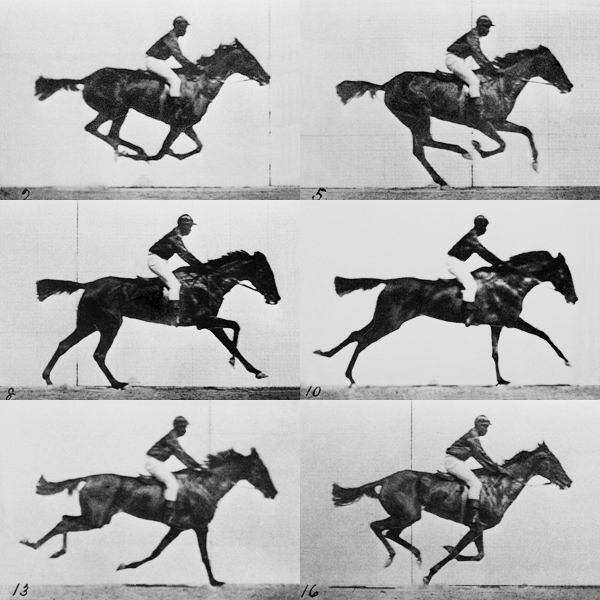
Eadweard Muybridge's "The Horse in Motion" (1878)
"Animals: The Most Moving Things in the World"
--Jim Mason in An Unnatural Order (2005 [1993])

“The animal look can be seen as a continuation of the photographic look... Animals appeared to merge with technological bodies that replaced them... If the animal cannot die but is nonetheless vanishing, then it must be transferred to another locus, anther continuum in which death plays no role... the cinema developed, indeed embodied, animal traits as a gesture of mourning for the disappearance of [animals]"
--Akira Lippit in Electric Animal (1998)


Moving Animals, Animal Affect, and Effective Movies
Since its inception, the animal movement has relied upon images to evoke sympathy--from William Hogarth's "The Four Stages of Cruelty" (1751) that connected cruelty to animal to cruelty to humans, to the anti-vivisectionist posters that re-figured the medical oppression of women to that of animal others, and PETA's "Holocaust on Your Plate" and "Animal Liberation" exhibits that juxtaposed images of human and nonhuman oppression. Undercover investigation footage of labs, in particular, played a crucial role in the 1980's, especially within the efficacy of the ALF and PETA (videos like Unnecessary Fuss and Inside Biosearch). However, with increased vandalism and exposure, the Animal Industrial Complex has been vigilant to guard its practices from public knowledge. Since the 1990's, these industries have installed hi-tech security systems in addition to lobbying for the Animal Enterprise Terrorism Act [AETA], which gained increasing government backing post-9/11. Such footage, has been crucial to educating the public about animal welfare within the age of televisions, computers, and cinema. Over the last decade, activists have even accompanied themselves with video harnesses to literally carry the animals' voices to protests and demos.

Read more »