Critical Animal Studies

Designed by Christie Nicole and Adam Weitzenfeld
Thought I'd share some quotes I've encountered  researching Human-Animal relations, ethics, and subjectivity as I pull together a post on the moral psychology of animal encounters. Enjoy!

Stories with animals are older than history and better than philosophy.
--Paul Sheppard

The more I spoke about animals, the less possible it became to speak to them.
--David Abram

Man becomes aware of himself returning the [animal’s] look… [Today] animals are always the observed. The fact that they can observe us has lost all significance... The more we know, the further away we are.
--John Berger

The most matter of fact person could not help thinking of the hogs they were so innocent they came so very trustingly and they were so very human in their protests and so perfectly within their rights... It was like some crime committed in a dungeon all unseen and buried out of sight and of memory... Relentless remorseless it was all his protests... his screams were nothing it it did its cruel will with him as if his wishes feelings had simply no existence at all it cut his and watched him gasp out his life

He had stood and watched the hog-killing, and thought how cruel and savage it was, and come away congratulating himself that he was not a hog; now his new acquaintance showed him that a hog was just what he had been--one of the packer's hogs!...What they wanted from a hog was all the profits that could be got out of him; and that's what they wanted form the working man... What the hogs thought of it, and what he suffered, was not considered; and no more was it with the working man... That was true everywhere under capitalism.
--Upton Sinclair

How many of my ancestors
Were treated like today’s farm animals?
How many of us look the other way?
When I hear of calves
Being taken from their mothers
To be sold as veal
I can hear the wailing voices of mothers
Crying for their babies
As the slave master takes them away
The mother cow breastfeeds the human race
My ancestors breastfed the white race
So when I looked into those stunned eyes today,
No one could have said to me,
‘What’s the big deal?’ ‘ It’s only an animal.’
I could have remembered a time
When someone might have said the same thing about me
--Mary Spears

The possibility of the pogrom is decided in the moment when the gaze of a fatally-wounded animal falls on a human being. The defiance with which he repels this gaze—‘after all, it’s only an animal’—reappears irresistibly in cruelties done to human beings, the perpetrators having again and again to reassure themselves that it is ‘only an animal,’ because they could never fully believe this even of animals
--Theodore Adorno

Men do all they can in order to dissimulate this cruelty or to hide it from themselves, in order to organize on a global scale the forgetting or misunderstanding of this violence that some would compare to the worst cases of genocide (there are also animal genocides)… conditions that previous generations would have judged monstrous, outside of every supposed norm of a life proper to animals that are thus exterminated by means of their continued existence or even their overpopulation.

No one can deny the suffering, fear or panic, the terror or fright that humans witness in certain animals… the response to the question "can they suffer?" leaves no doubt… War is waged over the matter of pity… To think the war we find ourselves waging is not only a duty, a responsibility, an obligation, it is also a necessity … I say "to think" this war, because I believe it concerns what we call "thinking."
--Jacques Derrida

There were seventy of us in a forestry commando unit for Jewish prisoners of War in Nazi Germany… halfway through our long captivity, for a few short weeks before the sentinels chased him away, a wandering dog entered our lives... we called him Bobby, an exotic name, as one does with a cherished dog. He would appear at morning assembly and was waiting for us as we returned, jumping up and down and barking in delight. For him, there was no doubt that we were men... This dog was the last Kantian in Nazi Germany, without the brain needed to universalize maxims and drives
--Emmanuel Levinas

However, even vegetarianism in your hands, would make a capital article... its connection with modern socialism, atheism, nihilism, anarchy and other political creeds... Brussels sprouts seem to make people bloodthirsty, and those who live on lentils and artichokes are always calling for the gore of the aristocracy and for the severed heads of kings... in the political sphere a diet of green beans seems dangerous.
--Oscar Wilde
Beehive Design Collective. "FTAA." Source: www.beehivecollective.org
Introduction
Some cyber-friends have been pestering me to put up another blog post since I haven't posted anything in three months--well, maybe that's an exaggeration but i really wanted to use the word pestering--, so  I'm posting two abstracts I recently submitted to the Thinking About Animals conference at Brock University (St. Catharines, ON, Canada) going on between March 1 and April 1, 2011. This will be the 10th Critical Animal Studies conference, and Brock is perhaps one of the most deserving universities since its establishment of a critical animal studies minor and an official vegan policy in the Sociology department.

On that note, I encourage you to check out the Critical Animal Studies resource page I created over winter break!!!

The first paper, on Frantz Fanon's The Wretched of the Earth, is a paper I wrote for Existentialism in the Fall. I went through some angst writing it, but came out overall satisfied with the paper. If any of you are interested in reading it, I'll send you a copy in exchange for some good feedback. The second paper ought to be more familiar to avid readers of this blog. It's basically a summation of what I have written on the understanding of veganism over the last two years or more.

1.
Decolonization and Animal Liberation:
Violence and Becoming-Animal in Frantz Fanon’s The Wretched of the Earth
In 1961, the Algerian psychoanalysist, Frantz Fanon, published, Les Damnés de la Terre, a book specifically about the revolutionary movement in French Algeria, but a guide to decolonization in general. In The Wretched of the Earth, Fanon gives a phenomenological account of the Algerian independence movement, from its inception in local, spontaneous violent uprisings, to a national political movement, to the development of a national culture and new humanism. For Fanon and his friend Sartre, violence is a necessity for the colonized to become fully human and political subjects. Similarly, the development of a national culture is necessary development for not only the liberation of Algeria, but for the future of humanity.

While Fanon’s primary goals are the achievement of national consciousness and a new humanism, a subversive reading of this text foregrounds “the animal” that beseeches his description of decolonization. Fanon’s characterization of the relationship between decolonization and animals is complex: on the one hand, animal being is to be transcended, if not negated through self-assertion and violence, yet the animal virtues of spontaneity, ferocity, and pack-forming are crucial for the overthrow of the colonizers. If humans’ metaphoric relationship to “animality” and animal others materialize in their relationship with one another, as is argued, then decolonization will not be achieved so long as a hierarchical and exclusionary identity politics exists between human and animal others (as is inferred by Fanon and Sartre’s subject-centered humanist discourse). It is argued that the anarchistic process of “becoming-animal” described by Gilles Deleuze and Félix Guatarri is a more transformative and promising alternative to humanism for not only human liberation, but also the liberation from humanist violence against “animality” and animal others.

2.
Deconstructing Veganism:
Love, Listening, Conversations, and Companionships Beyond Boundaries
For over a decade, Gary Francione (1996, 2008) has been championed for his bold challenge to the efficacy of “new welfarism” and the sufficiency of lacto-ovo-vegetarian advocacy in the contemporary “animal rights” movements. Yet relatively few animal abolitionists have ever challenged the sufficiency and status quo of veganism. In a time when neoliberalism has come into a greater appropriation of veganism (Hammer 2008), real animals have become absent from the discourse of many animal and vegan advocacy campaigns (Adams 2006), and to be a vegan is more about one’s way of life (i.e. the subculture one belongs to) than one’s actual relationship to animals, a more radical critique of not only vegetarianism but veganism too is needed.

While many celebrate the mainstreaming of veganism, I would like to caution self-identified vegans and animal activists from accepting the present understanding of vegan as an identity of (abstention from) consumption. The present understanding of veganism as a) an identity b) defined negatively as an abstention from c) consumption has lead to a certain modality of political and private life which has been legitimately accused of self-righteousness, identity politics, militancy, colonialism, and privileged consumerism. In light of this, we are called to a radical rethinking of veganism not as a noun (“ vegan”) to be identified with, purchased, consumed, and completed, but as a modality and relationship with others that is never yet complete.

Veganism is something to be understood affirmatively, as an affirmation of our own feelings and the voices of others. Those who have come into veganism as a liberation project must adamantly recall that they did not do so because of convenience, out of tradition, or merely out of pleasure, but because they are in search of affirming love. This love must never be forgotten as their point of departure and arrival. The ends of veganism are in the means of not forgetting, disavowing others. It is through disavowal that people commit the most violence by ignoring their own and others’ sentiments; they wage war on themselves and others for foreclosing ends, ideals, and identities, rather than waging conversation. The end of veganism is thus not to become a vegan, but to become other-wise in conversations and companionships beyond boundaries and “language.”

Read more »
Once upon a time in the summer of 2008, I interned at an animal sanctuary in upstate New York. It was by far one of the best experiences of my life, and certainly also one of the most transformative ones, but it was not without its growing pains. While living in the intern house for nearly four moths, a feeling grew within me that many people who dedicate them to animal issues are often in need of much healing, self-acceptance, and forgiveness. So many of the interns were on medication for emotional health or had serious self-esteem issues (including myself). It was a dramatic summer of people not only struggling against and with one another, but also with themselves. One intern left early due to the hard emotional and physical labor of caring for the animals, while others got in terrible feuds with their distant partners, or even fell into self-hatred and bewilderment.

I began to see some truth in animal studies literature that many people in western, industrial societies turn to animal others as emotional cruxes in a fragmented, disenchanted society. However, rather than thinking that animal others simply stood as surrogate humans, it seemed that perhaps there is something about animal others that gives us something more-than-human. It seems that we turn our attention to animal others when we cannot accept ourselves or other humans, or it is they (fellow humans) whom we feel have not accepted us. It’s no coincidence that animal therapy can be so powerful in prisons, with children, and in nursing homes. 
Animal others give us something few humans can give, even ourselves.
Read more »
I recently submitted this abstract to the "Sex Gender Species" Conference affiliated with the Summer 2011 issue of Hypatia: A Journal of Feminist Philosophy on "Animal Others." This is an adaptation from "The Identity Politics of Breasts" series I began researching approximately a year ago, posted last June and July, and updated and presented on June 27, 2010 at the "Animals and Animality" graduate conference at Queen's University. There is a lot being analysis being crunched into those fourth and fifth paragraphs, and quite a bit missing before the second. Hopefully, I won't have to cut out too much; but if I do,maybe it's for the better and will be material for a future paper.

The seeds for this research direction are numerous, but certainly the works of Karen Warren, Val Plumwood, and Carol Adams have been enormous early inspirations. Over the last four years, I am especially grateful to Tamara Ketabgian (Professor of English at Beloit College), Lauren Corman (Professor of Sociology at Brock University and co-host of Animal Voices), and Ida Hammer (of The Vegan Ideal) whose teachings have ruptured and transformed my ideas. I would love to hear any feedback on this. I can see several lines of criticism and would love to articulate a defense for my position /ideas just as much as I am open to a modification of them.


Queering the Breast and Cross-nursing Queer Kinships
The human breast is a cultural site at which dominant western discourses demarcate nature from culture, woman from man, human from animal, sacred parenthood from perverse sexuality, and generosity from self-interest (Schiebinger 2004). The objective of this paper it to queer sex, gender, and species identity in order to imagine different human-animal-food relations than those found in vegan literature today. Ultimately, I argue for the re-conceptualization of breasts as sites for queer productions that nourish cohabitation across difference and subvert cissexism, hetero-patriarchy, human supremacy, and the human-animal dichotomy.

Feminist scholars on breastfeeding have critiqued both the commodificaiton of breasts as objects of male desire as well as contemporary disciplinary state and medical discourses on breastfeeding (Yalom 1997). Iris Marion Young’s (1990) chapter, “Breasted Experience,” has played a significant role in challenging the meaning of women’s breasts being measured by and for others (i.e. hetero-men, infants, the state) in that it proposes that a woman’s breasts ought to be for that woman, as they are constitutive of her as a subject. Young ultimately rejects a breasted experience based in “a love that is all give and no take,” arguing that a female sexual pleasure need not be mutually exclusive with maternal care (87).

In a recent paper, “Queer Breasted Experience,” Kim Hall argues that “the possibility and meaning of queer breasted experience… has been overlooked in [cissexual] feminist accounts” of subjectivity (2007, 16). Young’s account, she argues, omits the subjectivities of trans men who, born female-bodied, experience breasts more ambivalently than cis women. Essentialist and monistic accounts of female subjectivity, in other words, have ironically, in an attempt to recognize sexual difference between women and men, have thus eliminated the recognition of sexual difference among female-bodied people who do not recognize themselves as women. Just as violence to queer subjectivities have been done in the name of a single limit between man and woman, so to has violence been done in the name of the animal to the vast heterogeneities of animal others (Derrida 1997). Rethinking sex and species difference both is critical for living- and eating-well with others (Derrida 1991).

In more ways than one, breasts offer an apt site at which to throw into question sex, gender, and species essentialism. First, breastfeeding is not a capacity exclusive to female-bodies; male-bodies, too, can produce milk and nurse children (Diamond 1998; Giles 2003). Second, breastfeeding need not be exclusively practiced between child and biological parent, but any parent who is lactating, even if of another species. Human-animal cross-species nursing has been practiced in cultures worldwide, including the West, perhaps since the domestication of dogs (Serpell 1986; Baumslag and Michels 2005; Olmert 2009). Third, food represents a new way of thinking subjectivity beyond sexual difference, in which we eat our way into new identities (Probyn 2000). Breasts thus offer a site at which sex, gender, and species identities can proliferate through creative, queer assemblages.

Condemning any and all human-animal-food relation as intrinsically exploitative assumes, or at least prescribes, species essentialism. For example, in her paper “Disturbing Images,” Maneesha Deckha welcomes a PETA video (in which young women lift up their shirts to reveal udders and ecstatically spray milk at men) because it subverts both the medicalized and hetero-normative discourses of the Madonna-and-child dyad as well as “the wholesome image of [cows’] milk” (2008, 63). Ironically, Deckha commits herself to the very hetero-normative discourse she opposes by asserting that cows’ milk is “meant for that mammal’s offspring,” repeating several times how “unnatural” it is for humans to drink it (64). Deckha’s privileging of the abjectness of the video makes it difficult to imagine more productive and transformative human-animal-food relations that do not reproduce the species barriers she wants to overcome. At least when human women are nursing animal others, audiences are most disturbed by what they interpret to be the woman’s perverse pleasure and disloyalty to her species (Luke 2007). In such instances, cross-species nursing subverts the human-animal dichotomy, but also human supremacy and hetero-patriarchy.

One need not fear that by appraising cross-species nursing they will have committed themselves to the evolutionary, postmodern accounts of naturecultures, which forfeit philosophical rigor for philosophical play (Haraway 2008). Instead, cross-species nursing offers vegan feminists a figure to redefine vegan human-animal-food relations as something other than privation and/or abstinence from consuming animals (and their products). Cross-species nursing disrupts the human-animal dichotomy, inverts the standard narrative applied to human-animal-food relations, and does not necessitate that either nurse or nursed be sacrificed for the nourishment of the other.
3. The Animals Film (Beyond the Frame 1981, 137min)

To my knowledge, The Animals Film was the first documentary to me made on the animal protection movement and the first to be aired on public television--an amazing feat given that it was released just 6 years after the publication of Animal Liberation, 1 year after Henry Spira's ad campaign against Revlon, 2 years before The Case for Animal Rights, and 3 years before Unnecessary Fuss. Filmed in the United States by an Israeli and released in England, TAF had been the most comprehensive film on animal welfare up until the release of Earthlings 16 years later. Yet, despite its age, sadly, little has changed since its release except that industry practices and problems have increased in magnitude and extended into other countries. (In 1980, about 5 billion animals were slaughtered in America annually compared to nearly 9 billion by 2000). In fact, it is my opinion that despite the praise for Earthlings and the absence of knowledge about this film, TAF is better. (Whether it is more effective at recruiting vegans--Earthlings supposedly is nicknamed "the Vegan maker"--, that is for empirical studies to determine).

Read more »
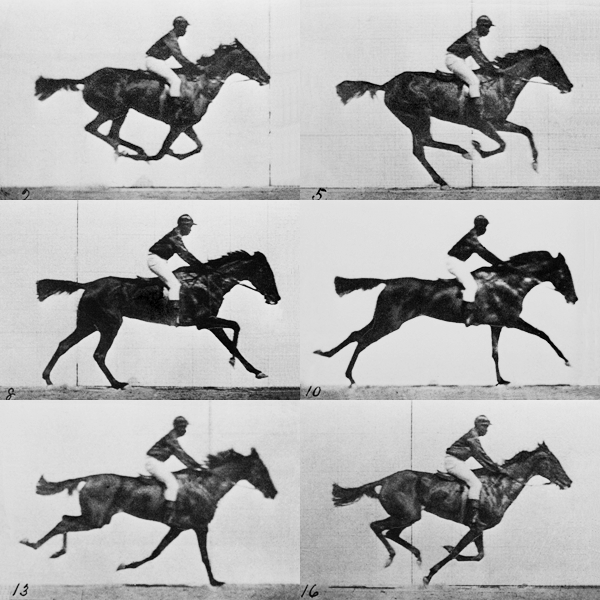
Eadweard Muybridge's "The Horse in Motion" (1878)
"Animals: The Most Moving Things in the World"
--Jim Mason in An Unnatural Order (2005 [1993])

“The animal look can be seen as a continuation of the photographic look... Animals appeared to merge with technological bodies that replaced them... If the animal cannot die but is nonetheless vanishing, then it must be transferred to another locus, anther continuum in which death plays no role... the cinema developed, indeed embodied, animal traits as a gesture of mourning for the disappearance of [animals]"
--Akira Lippit in Electric Animal (1998)


Moving Animals, Animal Affect, and Effective Movies
Since its inception, the animal movement has relied upon images to evoke sympathy--from William Hogarth's "The Four Stages of Cruelty" (1751) that connected cruelty to animal to cruelty to humans, to the anti-vivisectionist posters that re-figured the medical oppression of women to that of animal others, and PETA's "Holocaust on Your Plate" and "Animal Liberation" exhibits that juxtaposed images of human and nonhuman oppression. Undercover investigation footage of labs, in particular, played a crucial role in the 1980's, especially within the efficacy of the ALF and PETA (videos like Unnecessary Fuss and Inside Biosearch). However, with increased vandalism and exposure, the Animal Industrial Complex has been vigilant to guard its practices from public knowledge. Since the 1990's, these industries have installed hi-tech security systems in addition to lobbying for the Animal Enterprise Terrorism Act [AETA], which gained increasing government backing post-9/11. Such footage, has been crucial to educating the public about animal welfare within the age of televisions, computers, and cinema. Over the last decade, activists have even accompanied themselves with video harnesses to literally carry the animals' voices to protests and demos.

Read more »
Sue Coe. 2004. "Ox Pull." From "Bully!: master of the Global Merry-go-round" Source: http://www.graphicwitness.org/coe/bullya.htm
"However, even vegetarianism in your hands, would make a capital article...  its connection with modern socialism, atheism, nihilism, anarchy and other political creeds... Brussels sprouts seem to make people bloodthirsty, and those who live on lentils and artichokes are always calling for the gore of the aristocracy and for the severed heads of kings... in the political sphere a diet of green beans seems dangerous." -Oscar Wilde, The Complete Letters, p. 334, from a letter dated Nov. 12, 1887.

Introduction
Ten months ago, Paul D'Amato's article  "Socialism and 'animal rights'" sparked a small controversy that fizzled out within a month of its release. Unfortunately, out of the dozen responses only two or three were more argument than opinion. My aim here is to provide a more rigorous and comprehensive critique of D'Amato's article absent in the responses in order to better reconcile the perceived tension between socialistm and animal rights.

In "Socialism and 'Animal Rights'," D'Amato's reasoning starts off strong, making critical and important insights on the idea of animal liberation; however, it soon strays into weak, dangerous, and unnecessary territory. D'Amato comes to several conclusions (not presented in this order):

  1. "There is a clear connection between how a rapacious capitalism mistreats animals... environment... [and] human[s]"
  2. "Non-human animals are helpless… incapable of organizing and fighting for their rights"
  3. "To compare the condition of animals to that of... [humans] for freedom and equality is to view the latter through a paternalistic lens, rather than a lens of human liberation"
  4. "we need to insist on the essential differences between human beings and other animals, and reject the idea of 'animal liberation.'"
  5. "seeking more humane treatment of animals is not the same as calling for 'animal rights'"
In the first conclusion, he displays sympathy for nonhuman animals and their human allies. In the second, D'Amato properly points out the obvious but sometimes overlooked fact that no other (with a possible exception of a few) species can and/or is capable of politically organizing to declare their rights. This point leads into the subtitle and thesis of D'Amato's piece: to compare the animal liberation movement to human liberation movements is paternalistic (and reeking of white, middle-class, male privilege).

I'm totally on board with D'Amato's thesis if we are only discussing movements and not also mental, material, and legal outcomes. But he does not enclose his argument to his thesis; he continues on to argue that humans are essentially different from all other animals (despite being careful to say that humans are only "qualitatively" different"), and that the "liberation" and rights of nonhuman animals be rejected in favor of merely "more humane treatment." It is these last two conclusions, I find objectionable and weakly argued.

In this response, I will critique four positions D'Amato either asserts or  ignores. First, he implicitly argues that one cannot have rights unless one asserts one has them, a contractualist argument that would exclude many humans from possessing rights. Second, he explicitly draws on evolutionary biology to make arguments for an essential difference between humans and other animals that contradict themselves and are analogous to arguments that have been used to rationalize racism. Third, D'Amato misses how worker and animal exploitation are not only  increased by capitalism, but that they are intersecting oppressions that mutually reinforce one another just as socialism and animal rights are ethico-political positions that intersect and mutually reinforce one another. Finally, he is naive to the historical, cultural, and ecological ties between the exploitation and well-being of human and animal.


Read more »